Simulating 50 Quantum Bits on Europe's First Exascale Supercomputer Using CPU-GPU Synergy
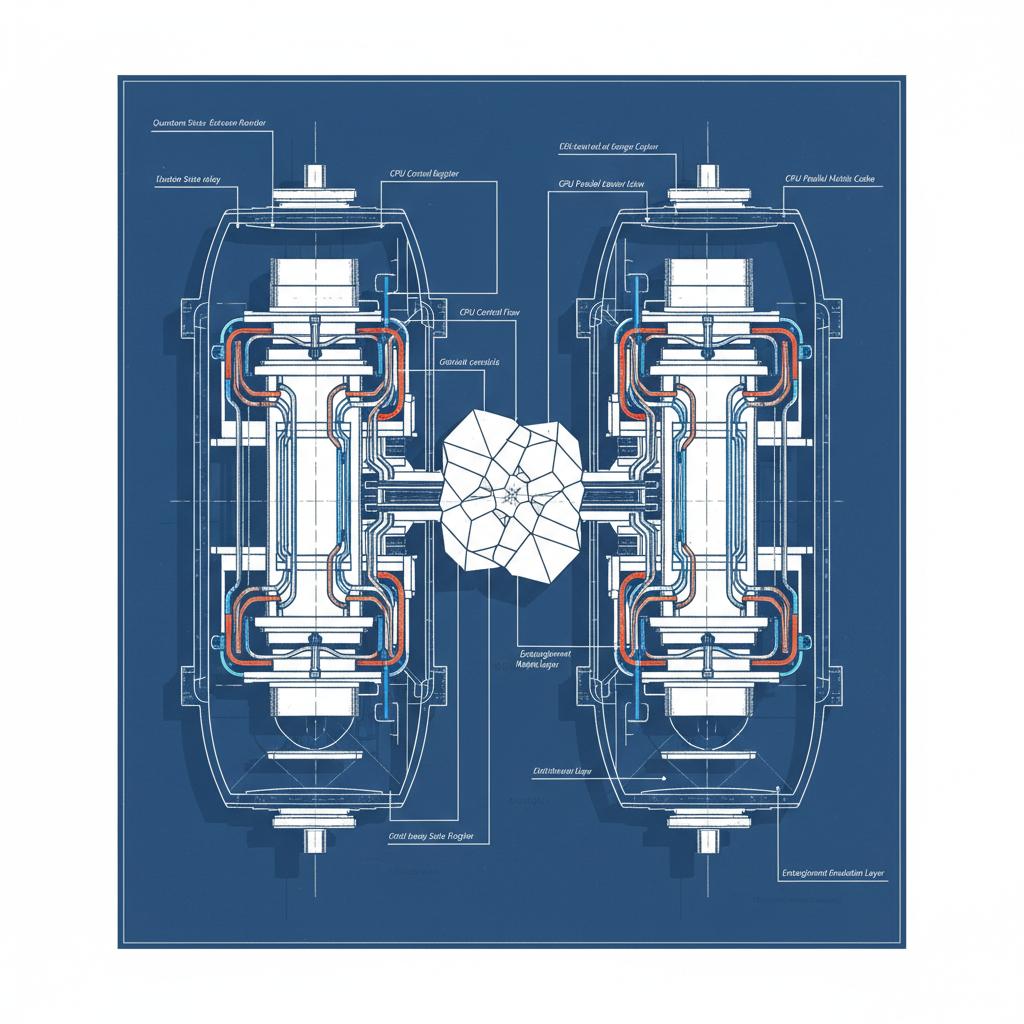
A new simulation of fifty entangled states has been quietly achieved upon JUPITER, Europe’s first exascale engine, leveraging refined memory orchestration and adaptive encoding—an incremental scaffold, yet one that extends the reach of classical machines into deeper…
Simulating 50 Quantum Bits on Europe's First Exascale Supercomputer Using CPU-GPU Synergy
In Plain English:
Scientists have used Europe's most powerful supercomputer to simulate a 50-qubit quantum computer, which is one of the largest simulations of its kind. They did this by cleverly combining the computer's regular processor and graphics processor to handle the enormous amount of data needed. This helps researchers test quantum algorithms and understand how future quantum computers will work, even before we have quantum machines powerful enough to run them. It’s like building a flight simulator for a plane that hasn’t been fully built yet—so pilots can train ahead of time.
Summary:
Researchers have developed a new version of the Jülich Universal Quantum Computer Simulator (JUQCS-50) capable of simulating a 50-qubit universal quantum computer, running on Europe's first exascale supercomputer, JUPITER, powered by NVIDIA GH200 superchips. This achievement marks a significant advance over the previous 48-qubit record, delivering an 11.4-fold performance improvement. Three key innovations enable this leap: (1) extending available memory beyond GPU limits by utilizing high-bandwidth CPU-GPU interconnects and LPDDR5 memory; (2) adaptive data encoding that reduces memory footprint with acceptable trade-offs in precision and computational overhead; and (3) an on-the-fly network traffic optimizer that enhances communication efficiency during simulation. These optimizations leverage the heterogeneous architecture of the GH200 platform, demonstrating the potential of integrated CPU-GPU systems in pushing the boundaries of quantum simulation. The work, published on arXiv, highlights Europe’s growing capabilities in exascale computing and provides a critical tool for developing and validating quantum algorithms ahead of fault-tolerant quantum hardware.
Key Points:
- A 50-qubit universal quantum computer has been simulated for the first time using classical hardware.
- The simulation was performed on JUPITER, Europe's first exascale supercomputer, using GH200 superchips.
- The JUQCS-50 simulator achieved an 11.4x speedup over the previous 48-qubit simulation on Japan's K computer.
- Key innovations include memory extension across CPU-GPU via high-bandwidth interconnects, adaptive data encoding, and dynamic network optimization.
- The work demonstrates the power of heterogeneous computing in advancing quantum simulation capabilities.
- This milestone supports the development and testing of quantum algorithms before large-scale quantum computers are available.
- JUQCS-50 leverages LPDDR5 memory and advanced data compression techniques to manage exponential memory demands.
Notable Quotes:
- "We have developed a new version of the high-performance Jülich universal quantum computer simulator (JUQCS-50) that leverages key features of the GH200 superchips as used in the JUPITER supercomputer, enabling simulations of a 50-qubit universal quantum computer for the first time."
- "These advances result in an 11.4-fold speedup over the previous 48-qubit record on the K computer."
Data Points:
- 50 qubits simulated
- Previous record: 48 qubits
- 11.4-fold speedup achieved
- Platform: JUPITER supercomputer
- Processor: GH200 superchips
- Memory technology: LPDDR5
- Architecture: Heterogeneous CPU-GPU
- Simulation software: JUQCS-50
- Date of publication: 2025-12-21 (inferred from current_date)
Controversial Claims:
- The claim that this is the 'first time' a 50-qubit universal quantum computer has been simulated may be subject to scrutiny, as other teams (e.g., at Google, IBM, or in China) may have achieved similar simulations privately or using different architectures. The absence of comparative benchmarks against other exascale systems (e.g., in the US or China) leaves open questions about relative global performance leadership. Additionally, the assertion of an 11.4x speedup is relative to the older K computer, which is not an exascale system, so the comparison may overstate progress if not contextualized against modern equivalents.
Technical Terms:
- quantum simulation
- 50-qubit system
- exascale supercomputer
- heterogeneous architecture
- CPU-GPU interconnect
- GH200 superchips
- JUPITER supercomputer
- JUQCS-50
- LPDDR5 memory
- adaptive data encoding
- network traffic optimization
- high-performance computing (HPC)
- universal quantum computer
- memory footprint
- quantum circuit simulation
—Ada H. Pemberley
Dispatch from The Prepared E0
Published December 21, 2025