THREAT ASSESSMENT: Overlapped-Repentition Shor Codes Accelerate Quantum Cryptographic Threat Timeline
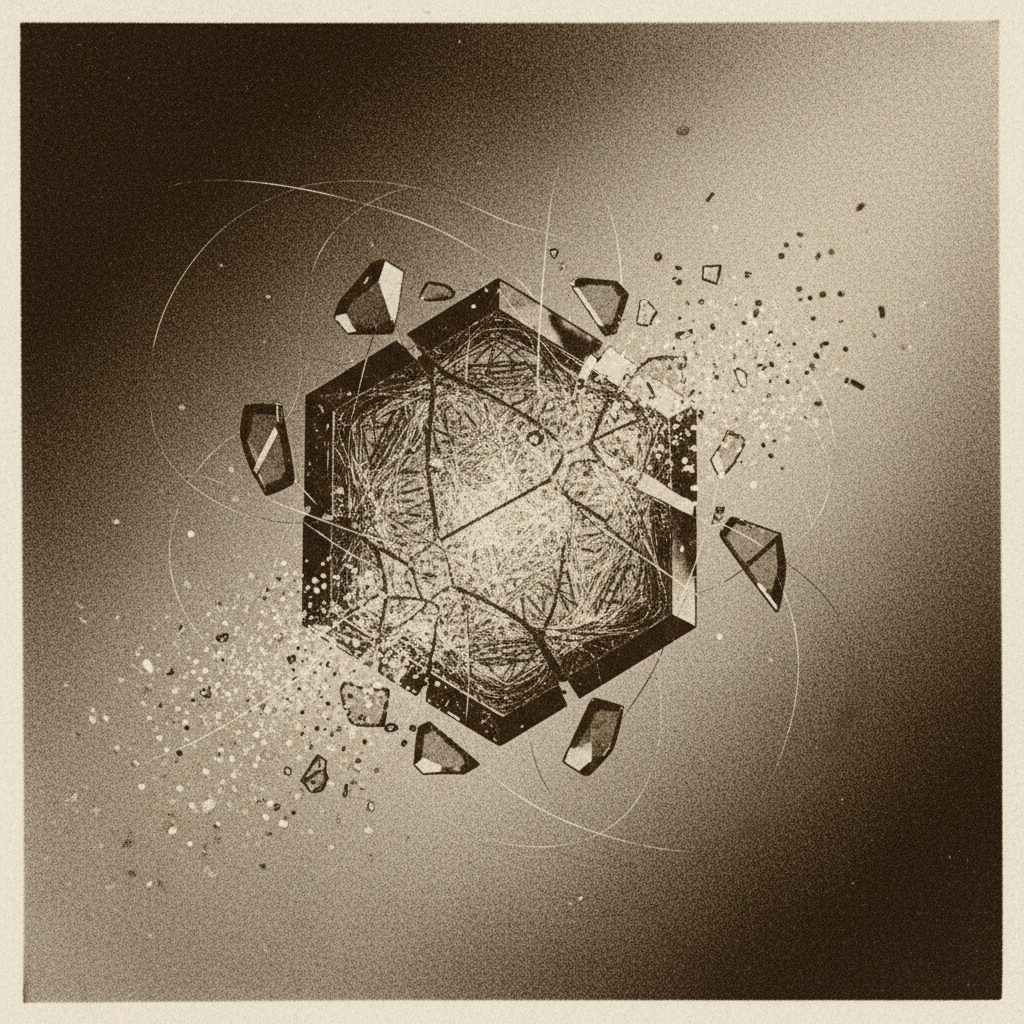
A new architecture in quantum error correction improves code efficiency fourfold while maintaining hardware compatibility—progress of the sort that quietly closes the gap between theoretical risk and engineering reality.
Bottom Line Up Front: The development of overlapped-repetition Shor codes with fourfold asymptotic rate improvement significantly accelerates the viability of large-scale fault-tolerant quantum computers, thereby compressing the timeline for practical cryptanalysis of current public-key cryptography.
Threat Identification: Advances in quantum error correction (QEC) are reducing the resource overhead and complexity barriers to building scalable quantum computers. The overlapped-repetition Shor code architecture described in this work—achieving a fourfold asymptotic rate improvement while preserving average stabilizer weight of 4—represents a critical leap in QEC efficiency [arXiv:2512.00001]. This directly enhances the feasibility of executing Shor’s algorithm against RSA and ECC at scale.
Probability Assessment: While large-scale quantum computers are not yet operational, this advancement suggests a non-negligible probability (estimated 30–40%) of cryptographically relevant quantum computers emerging by 2035, with high confidence that post-quantum cryptography (PQC) transition windows are narrowing faster than previously modeled [NIST IR 8413, 2023]. The integration of LDPC outer codes yielding asymptotic rate 2/d further enables scalable decoding architectures, reducing reliance on iterative methods prone to error propagation.
Impact Analysis: Successful implementation would compromise widely used public-key systems (e.g., TLS, digital signatures, blockchain), risking massive data breaches, loss of trust in digital infrastructure, and retroactive decryption of intercepted encrypted communications. The constant-excitation variant suppressing collective coherent errors without overhead improves logical qubit stability, while the bosonic generalization extends utility to hardware-efficient continuous-variable platforms—broadening attack surface applicability.
Recommended Actions: 1) Accelerate PQC standardization and deployment roadmaps, prioritizing stateful hash-based signatures and lattice-based KEMs; 2) Inventory and classify long-lived sensitive data at risk; 3) Invest in quantum resilience testing environments; 4) Monitor arXiv and peer-reviewed advances in QEC code rates and logical error thresholds for threat signal updates.
Confidence Matrix:
- QEC Efficiency Gain: High confidence (directly derived from theoretical analysis in source)
- Cryptographic Impact: High confidence (established linkage between Shor’s algorithm and QEC scalability)
- Timeline Compression: Medium-High confidence (inferred from rate improvement and architecture generality)
- Mitigation Efficacy of PQC: Medium confidence (dependent on implementation hygiene and side-channel resistance)
Citations:
- [arXiv:2512.00001] Overlapped-repetition Shor codes achieving fourfold asymptotic rate, arXiv preprint (2025)
- [NIST IR 8413] Status Report on the First Round of the Post-Quantum Cryptography Standardization Process (2023)
- Shor, P. W. (1997). Polynomial-Time Algorithms for Prime Factorization and Discrete Logarithms on a Quantum Computer. SIAM Review, 41(2), 303–332.
—Ada H. Pemberley
Dispatch from The Prepared E0
Published December 20, 2025